
Moving into a senior living community is a huge life change. It marks a new chapter where you might be looking for more safety, social activities, or daily help. For many of us, this move is bittersweet. We are excited about the amenities but worried about what we might leave behind. The biggest worry for many seniors is their pets. Our animals are not just pets; they are our family members. They provide a sense of purpose and a deep level of comfort that people often cannot provide. When an animal helps someone with a mental health condition or an emotional struggle, we call them an Emotional Support Animal or ESA. At RealEsaLetter, we focus on helping people keep these important bonds. We believe that your mental health should be a priority no matter where you live.
The world of senior housing can be very confusing. You might hear terms like independent living or assisted living and wonder what they mean for your dog or cat. People often think that once they move into a facility, they lose their rights. This is a common myth that we want to debunk. You have legal protections that follow you into these communities. These laws were created to make sure that people with disabilities are treated fairly. Having an emotional support animal is a recognized way to manage many conditions that seniors face, such as loneliness, anxiety, or depression.
In this long guide, we are going to explore the key differences between housing types. We will talk about how the law looks at your room in an assisted living center versus a private apartment in an independent living complex. We want to give you the tools to talk to managers and directors with confidence. You should never feel like you have to sneak an animal in or hide your needs. We are here to explain the rules in plain English so you can focus on enjoying your new home.
We also want to help families who are helping their parents move. It can be stressful to manage all the paperwork and the logistics of a move. Understanding ESA rights can take one big worry off your plate. We will walk through the documentation you need and how to handle any pushback you might get. Our goal is to make sure every senior who needs an emotional support animal is able to have one. Let us dive into the details of how these rights work across different care settings.
How ESA Rights Differ by Housing Type
The first thing we need to look at is how the government defines where you live. Not all buildings are treated the same under the law. The most important law for us is the Fair Housing Act, which covers most places where people live long term. If a building is considered a dwelling, then the Fair Housing Act applies. This law says that landlords must allow emotional support animals even if they have a no pets policy. Most senior living communities fall under this rule because they are meant to be permanent homes for the residents.
Independent living is usually the easiest category to deal with. In these communities, you are essentially a tenant in an apartment. You have a lease, you have your own kitchen, and you come and go as you please. Because it is so similar to a standard apartment, your ESA rights are very strong. The management has to treat your request for an emotional support animal as a request for a reasonable accommodation. They cannot treat you differently just because the building is for seniors.
Assisted living can be a bit more complicated. These facilities offer more than just a place to sleep. They provide meals, help with bathing, and medical monitoring. Some people argue that these facilities are more like hospitals than homes. However, the legal trend is to treat assisted living units as dwellings. If you have a private or semi-private room that you live in full time, it is your home. This means you still have protections under the Fair Housing Act. The level of care you receive does not automatically take away your housing rights.
The main difference comes down to the environment. In a standard apartment, you are mostly on your own. In assisted living, staff members are in and out of your room. This means the facility has more say in how the animal behaves. They need to ensure that the animal does not stop the staff from doing their jobs. We like to tell people that while the rights are similar, the responsibilities might be a bit higher in a care-based setting. You have to be more mindful of how your animal interacts with the people who are there to help you.
Definition of Assisted Living Facilities
Assisted living is a special kind of housing designed for people who need some help with daily life but do not need constant medical care. We often see people move here when they find it hard to cook for themselves or keep up with a big house. In an assisted living facility, you usually get a private apartment or a suite. You have access to shared dining rooms and activity centers. The goal is to keep you independent for as long as possible while providing a safety net of support.
Because these facilities provide services, they are regulated by the state. This means they have to follow specific rules about safety and staffing. However, they are still considered residential housing. When you move into assisted living, you are not a patient in a hospital; you are a resident in a community. This distinction is very important for your ESA rights. Since it is your residence, the rules for fair housing still apply to your private living space.
We often see assisted living facilities offer the following services:
- Help with personal hygiene and dressing
- Management of medications
- Three meals a day in a group setting
- Housekeeping and laundry services
- Social activities and local transportation
Even with all these services, the room you pay for is your private domain. You have the right to have things in that room that help you live a better life. This includes medical equipment, and it also includes an emotional support animal. The facility cannot tell you that you are not allowed to have an ESA just because they provide you with medicine or help you get dressed. Your mental health is just as important as your physical health in these settings.
We believe that assisted living is one of the places where ESAs are needed the most. The move to such a facility can feel like a loss of freedom for some seniors. Having a loyal dog or a purring cat can make that transition feel much smoother. It gives the resident something to care for and a source of constant unconditional love. We always encourage facilities to see ESAs as a benefit to their community rather than a burden.
Independent Living Housing Explained
Independent living is often called retirement living or 55 plus communities. These places are designed for active seniors who want to live around people their own age. You might live in a small house, a townhouse, or an apartment. You are responsible for your own daily life. You do your own shopping, cooking, and cleaning, although some places offer optional services like a meal plan or a cleaning lady. It is all about lifestyle and convenience.
In this setting, the relationship between you and the management is a traditional landlord and tenant relationship. This makes the ESA process very clear. If the community has a rule that says no pets or has weight limits on dogs, those rules do not apply to your ESA. You are not asking for a pet; you are asking for a tool that helps you manage a disability. The management must engage in a dialogue with you to figure out how to make it work.
Here are some common features of independent living:
- Private entrances and full kitchens
- No daily medical or personal care provided by the staff
- Clubhouses, gyms, and communal gardens
- Security features like gated entries or emergency pull cords
- A focus on social events and peer interaction
Because you are living independently, the responsibility for the animal is entirely on you. You have to be able to take the dog out or clean the litter box. The facility staff will not help with these chores because that is not the level of care they provide. If you are able to care for yourself and your home, you are expected to care for your animal. This independence is what makes these communities so great for active seniors who have a strong bond with their animals.
We find that independent living communities are usually very welcoming to ESAs once they see the proper paperwork. They understand that happy residents stay longer and create a better atmosphere. If you are moving into one of these places, you can feel confident that your rights are well protected. It is your home, and you have the power to make it a place that supports your emotional well-being.
Federal ESA Protections Across Care Settings
Federal law is the big umbrella that protects everyone in the United States. When it comes to housing, there are a few key laws you should know. We already talked about the Fair Housing Act, but there is also Section 504 of the Rehabilitation Act. This law says that any housing that gets money from the federal government cannot discriminate against people with disabilities. Many senior living centers get federal money through programs like HUD or specialized grants.
If you live in a place that gets federal funding, they have to follow even stricter rules. They cannot just say no to an animal because it is inconvenient. They have to prove that having the animal would be an undue financial burden or would fundamentally change the nature of their services. In almost every case, having a cat or a dog in a private room does not meet that high bar. This means your protections are very robust.
For those living in the Pacific Northwest, you might be looking for an esa letter idaho to show your local housing provider. Even though the laws are federal, having a letter that is compliant with local expectations is always helpful. Federal law sets the minimum standard, and no state or facility can offer less protection than what the federal government requires. This gives you a strong foundation to stand on if you ever feel like your rights are being challenged.
We also have to think about how these laws apply to common areas. While the Fair Housing Act focuses on your living unit, it also says you must have equal access to the whole facility. This means you should be able to take your ESA into the hallways or the lobby to get outside. Some facilities might try to limit the animal's access to the dining hall or the therapy room for health reasons. While they can have some rules for shared spaces, they cannot make it impossible for you to live your life.
When Medical and Care Rules Limit ESA Rights
Even though your rights are strong, there are some specific situations where a facility might be able to limit or deny an ESA. This usually happens when the animal poses a direct threat to the health and safety of others. In a care-based setting like assisted living, there are more people who might be vulnerable. For example, if your animal is aggressive or bites a staff member, the facility has a legal right to ask that the animal be removed. Safety always comes first in a community setting.
Another limit involves the actual care being provided. If you are in a high-intensity unit, such as a specialized memory care ward, the rules might be different. In these areas, residents might be easily confused or prone to falling. If a dog is constantly underfoot in a narrow hallway where seniors are using walkers, the facility might argue that it is a safety hazard. They have to prove that the risk is real and cannot be fixed by a simple change, like keeping the dog on a short leash.
Specific state rules also play a role. If you are researching idaho esa laws, you will see that while they follow federal guidelines, they also emphasize the responsibility of the owner. You are responsible for any damage the animal does to the room. You are also responsible for making sure the animal does not disturb the peace of the building. If your dog barks all night and keeps twenty other seniors awake, the facility can take action because you are violating the right of others to enjoy their homes.
Here are a few reasons a facility might legally limit your ESA:
- The animal has a history of aggressive behavior or biting.
- The animal causes significant property damage that you cannot pay for.
- The animal creates a health hazard, such as severe flea infestations.
- The resident is unable to care for the animal and has no one to help.
- The presence of the animal fundamentally alters the medical services provided.
It is important to be honest with yourself about your animal's behavior. Most ESAs are calm and helpful, but if your pet is wild or untrained, it might be hard to keep them in a care-based facility. We always recommend basic obedience training for any dog that will be living in a senior community. It makes life easier for you, your neighbors, and the staff. Being a responsible owner is the best way to ensure your ESA rights are respected.
Documentation Requirements in Assisted Living
To get the legal protections we have been talking about, you need the right documents. You cannot just tell a facility manager that your dog is an ESA. You need a formal letter from a licensed mental health professional. This letter is the key that unlocks your rights. It proves that you have a disability and that the animal is a necessary part of your treatment. Without this letter, the facility can legally treat your animal as a pet and charge you fees or tell you no.
The letter should be on the professional's letterhead and include their license number and contact information. It does not need to go into deep detail about your medical history. In fact, you have a right to keep your specific diagnosis private. The letter just needs to state that the professional is treating you and that they recommend an emotional support animal to help with your symptoms. This keeps your private business private while still giving the facility the proof they need.
We often see people get confused by websites that sell "registries" or "badges." Please know that these do not carry any legal weight. A badge or a certificate from a random website is not a replacement for a letter from a real doctor or therapist. Many facilities are becoming very strict about checking these letters because they want to make sure the requests are legitimate. We suggest getting your letter from someone you have a real relationship with or a service that connects you with real professionals.
When you have your letter, it is a good idea to check an ESA state compliance guide to make sure you have everything you need for your specific area. Some states have small extra rules about how the letters should be dated or how often they should be updated. Being prepared with the right paperwork shows the facility that you are serious and that you know the law. It makes it much harder for them to say no when you have all your ducks in a row.
ESA Rights of Seniors and Disabled Residents
Seniors are a protected group under the law for many reasons. As we age, we often face new physical and mental challenges. The law defines a disability very broadly. It is anything that significantly limits a major life activity. For many seniors, things like sleeping, concentrating, or interacting with others can become difficult due to mental health struggles. If an animal helps you do those things better, you are protected. We believe that everyone should be able to live with dignity and support.
The bond between a senior and their animal is often the strongest one they have. When children move away or friends pass on, an animal stays by your side. This is why the Fair Housing Act is so vital for the elderly. It prevents them from being forced into a heartbreaking choice. No one should have to choose between getting the care they need in a facility and keeping the animal that gives them a reason to live. We see this as a matter of basic human compassion as well as a legal right.
We also support efforts for Stricter ESA regulation support because it protects the people who truly need these animals. When people abuse the system, it makes it harder for seniors with real disabilities to be taken seriously. By having clear rules and high standards for documentation, we ensure that the rights of truly disabled residents remain strong. We want the system to work for the people who rely on it the most.
If you are a resident or a family member, remember that you are the expert on your own life. You know how much that animal helps. Don't be afraid to speak up about it. Senior living is supposed to be about improving your quality of life. An ESA is a major part of that for many people. Whether you are dealing with the early stages of memory loss or just a deep sense of isolation, your rights are there to make sure you have the help you need.
Facility Policies That Conflict With ESA Law
It is very common to find that a facility's handbook has rules that conflict with federal ESA laws. Many of these handbooks were written by lawyers who were thinking about pets, not ESAs. For example, a facility might have a rule that says no pets over 25 pounds. If you have a 50 pound dog that is a legitimate ESA, that weight limit does not apply to you. The law says the facility must make a reasonable accommodation, and a weight limit is generally not a valid reason to deny an animal.
Another conflict often comes up regarding pet deposits. Most senior living places charge a fee to have an animal. They might call it a pet deposit or monthly pet rent. Under the Fair Housing Act, they are not allowed to charge these fees for an emotional support animal. Since the animal is not a pet, these fees are considered discriminatory. You should not have to pay extra to have your medical accommodation in your home. This can save seniors hundreds or even thousands of dollars over time.
We also see rules about where animals can go. Some places try to say that ESAs must stay inside the resident's room at all times. This is usually not allowed. While the animal might not be allowed in the kitchen where food is being prepped, they should be allowed to walk through the building to get outside. They should also be allowed in common areas where other residents gather, as long as they are well behaved. If you feel like your animal is being unfairly restricted, it might be time to have a talk with management.
Here are some common facility rules that might be illegal when applied to ESAs:
- Charging a non-refundable pet fee or monthly pet rent
- Banning specific breeds like Pit Bulls or German Shepherds
- Setting strict height or weight limits for the animal
- Requiring the animal to wear a vest or a tag at all times
- Asking for the animal's training certificates (ESAs don't need formal training)
If you see these rules in your contract, don't worry. You can still ask for your accommodation. We suggest doing it in writing so there is a record of your request. Most managers are willing to listen once they understand that an ESA is different from a pet. If they are not sure about the rules, you can show them information from the ESA BBB accreditation meaning pages or HUD websites. Information is your best friend when dealing with outdated policies.
Handling Denials in Care-Based Housing
Getting a denial can feel like a punch in the gut. It is emotional and stressful. However, a denial is not always the end of the road. Sometimes it is just the beginning of a conversation. If a facility says no, stay calm. Ask them to give you the denial in writing and to list the specific reasons why they are saying no. This is your right. Often, once a manager has to write it down, they realize their reason might not hold up under the law.
Sometimes a denial happens because the facility has a concern they haven't talked to you about yet. Maybe they had a bad experience with a dog in the past. You can offer to meet with them and introduce your animal. Showing them that your cat is quiet or your dog is well trained can go a long way. You can also offer to have a third party, like a vet or a trainer, vouch for the animal's behavior. This shows that you are willing to be a partner in keeping the community safe.
There are also times why we turn down esa letter requests ourselves if we feel the situation doesn't meet the legal standard. We do this to protect the integrity of the process. If your request is legitimate and you have been denied by a facility, you might want to look at your documentation again. Is it current? Is it from a provider licensed in your state? Fixing these small details can sometimes turn a no into a yes.
If the facility is still being difficult, you can ask to speak to their legal department or their corporate office. Large companies that run senior living centers usually know the law better than the local manager. They want to avoid lawsuits and complaints to HUD. Once the corporate office gets involved, they often tell the local manager to allow the animal. Be persistent and keep a record of every person you talk to and what they say.
Complaint Options for Residents and Families
If you have tried to be reasonable and the facility is still breaking the law, you have the right to file a complaint. The best place to start is with the Department of Housing and Urban Development. HUD has a special office for Fair Housing and Equal Opportunity. You can file a complaint on their website for free. They will look at your case and if they find that the facility is discriminating against you, they can force them to change their policy and even pay you for the trouble they caused.
Families can be a huge help in this process. Moving is exhausting for seniors, and they might not have the energy to fight a legal battle. Children or grandchildren can step in and handle the paperwork. You can also contact your local Long Term Care Ombudsman. These are people whose whole job is to protect the rights of seniors in facilities. They are experts in local rules and can often mediate a solution without needing to go to court.
Another great resource is to check out organizations with high standards. For example, looking into the ESA BBB accreditation meaning can help you find companies that provide valid support for your claims. You want to make sure the people helping you are honest and reliable. Having a strong support team makes the complaint process feel much less scary.
Don't forget about your local representatives. Sometimes a call from a state senator's office or a local council member can get a facility to move much faster. These facilities care about their reputation in the community. If they are known for treating seniors poorly or breaking the law, it hurts their business. Use your voice and the resources around you to make sure your rights are respected. You are not just fighting for yourself; you are fighting for every senior who comes after you.
Planning Ahead Before Moving Facilities
The best way to handle ESA rights is to be proactive. If you are looking at different facilities, make the animal part of your initial search. When you go on a tour, look at how the staff interacts with animals. Do you see other residents with dogs? Is there a clean place to walk an animal? If the facility feels "pet friendly," they are much more likely to be "ESA friendly." It is much easier to move into a place that already welcomes animals than to fight a battle on day one.
You should also think about the specific needs of your animal as you age. If you are moving into a smaller apartment, a huge dog might be unhappy. Some seniors find that a cavachon therapy dog is a perfect fit for a facility because they are small, don't shed much, and are very gentle. Choosing the right companion for your new lifestyle can prevent a lot of problems down the road. You want an animal that can thrive in a smaller, quieter environment.
Before you move, get a letter from your doctor and have it ready to hand over with your application. Don't wait until the day you move in to bring it up. This gives the facility time to ask questions and get comfortable with the idea. It also shows that you are a responsible resident who follows the rules. We always say that transparency is the best policy. If you are open about your needs from the start, you can build a better relationship with the management.
Finally, have a backup plan. In the rare event that your animal becomes too much for you to handle or if the facility truly cannot accommodate them, know who would take care of the animal. This is just good planning for any pet owner, but it is especially important in senior living. Having a family member or a friend who can step in gives you peace of mind. It shows the facility that you have thought of everything and that the animal's welfare is being managed.
Do ESA Rights Change Between Assisted and Independent Living?
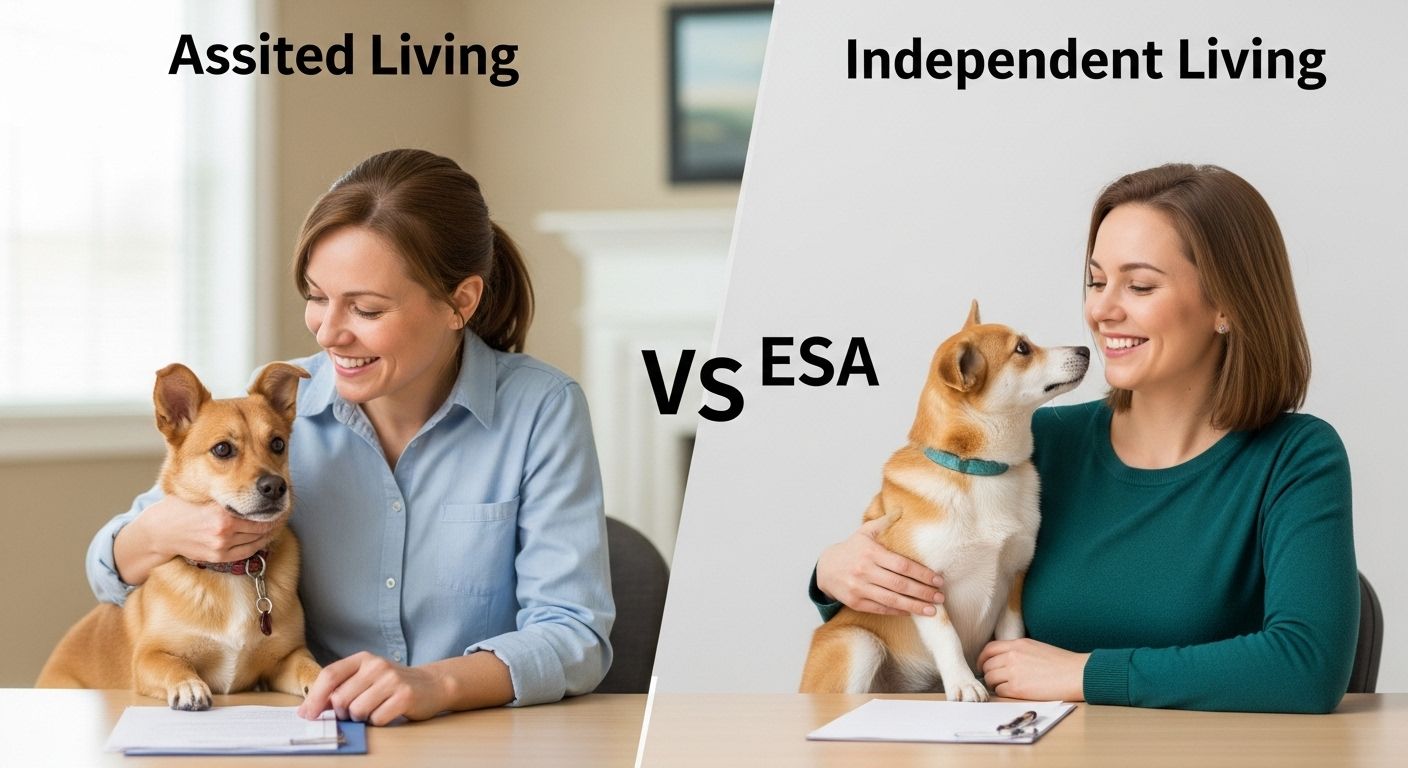
When we look at the big picture, the legal rights for emotional support animals are very similar in both assisted and independent living. Both settings are governed by the Fair Housing Act because they serve as your primary residence. This means that in both places, you are entitled to have an animal that helps with your disability without paying extra fees. The government wants to make sure that seniors can keep their support systems regardless of the level of care they need. The right to a reasonable accommodation is a fundamental part of living with a disability in America.
However, the way you experience these rights might feel different. In independent living, you have more privacy and fewer people coming into your home. This makes having an ESA feel very much like having one in a standard house. In assisted living, the communal nature of the building means you have to be more collaborative. You might have to coordinate with nurses, cleaners, and dining staff. While your right to have the animal is the same, your daily interactions with the facility staff will require more communication. You have to ensure that your animal is comfortable with strangers entering your room frequently.
As your health needs change, you might even consider different kinds of animal support. Some people start with an ESA but eventually find they need a service dog for physical help with balance or fetching items. Knowing about different service dog breeds can be helpful if you find your physical mobility decreasing. Service dogs have even more rights than ESAs, including the right to go into any public area like a restaurant or a doctor's office. Understanding all your options ensures that you always have the best support for your specific situation.
We want you to feel empowered as you make this move. Your emotional support animal is a key part of your health and happiness. By knowing the law and being prepared, you can ensure that your transition into senior living is a success. You don't have to leave your best friend behind. Whether you are moving into a bustling independent living community or a supportive assisted living suite, your ESA has a legal place by your side. We are proud to help you protect that bond and wish you the very best in your new home. Keep your head up, keep your documents ready, and enjoy the wonderful comfort that only an animal can provide.